Note: I originally wrote this post in 2018 for my old blog. I have edited and updated it for posting here.
I lived in Edinburgh for more than 7 months before I finally visited Scotland’s other major city, Glasgow. With a population of about 632,000 people, it is the largest city in Scotland as well as the third largest city in the United Kingdom. It is also the fifth most visited city in the UK behind London, Edinburgh, Manchester, and Birmingham, and was rated by Lonely Planet as one of the top 10 tourist cities in 2008. Admittedly that was a long time ago, and Glasgow isn’t exactly Instagram-famous, but that should make it appealing to people who aren’t interested in crowded places and want to experience Scotland. Glasgow is often considered more “Scottish” than Edinburgh, which is still associated more with English imperialism, and the two cities do have a bit of a friendly rivalry. Most people seem to think that Edinburgh is a more aesthetically attractive city, but the inhabitants of Glasgow are very adamant about how much they love and prefer Glasgow. I’ve also heard from some people who lived there that they thought it was ugly at first, but they ended up loving it by the time they had to leave. I am still very much biased toward Edinburgh. You can’t reliably compare a place you’ve lived in to a place you’ve only visited except on very surface level criteria. Based on my day trip to Glasgow, I did not find it to be ugly and I discovered that it has its own unique charms.
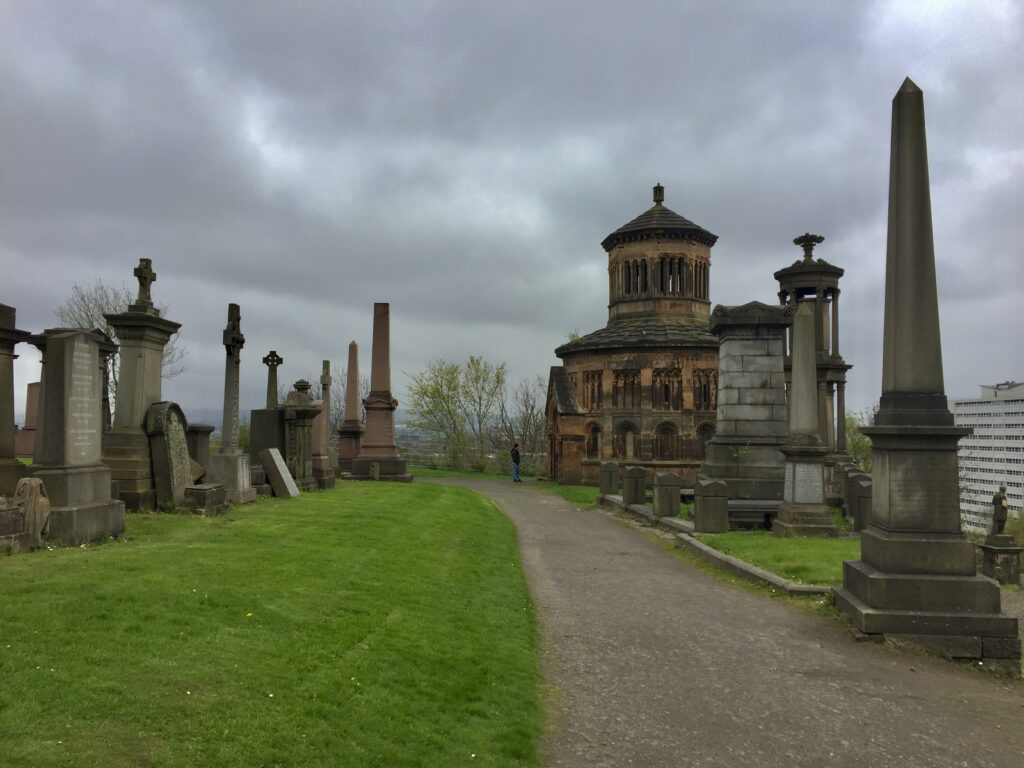
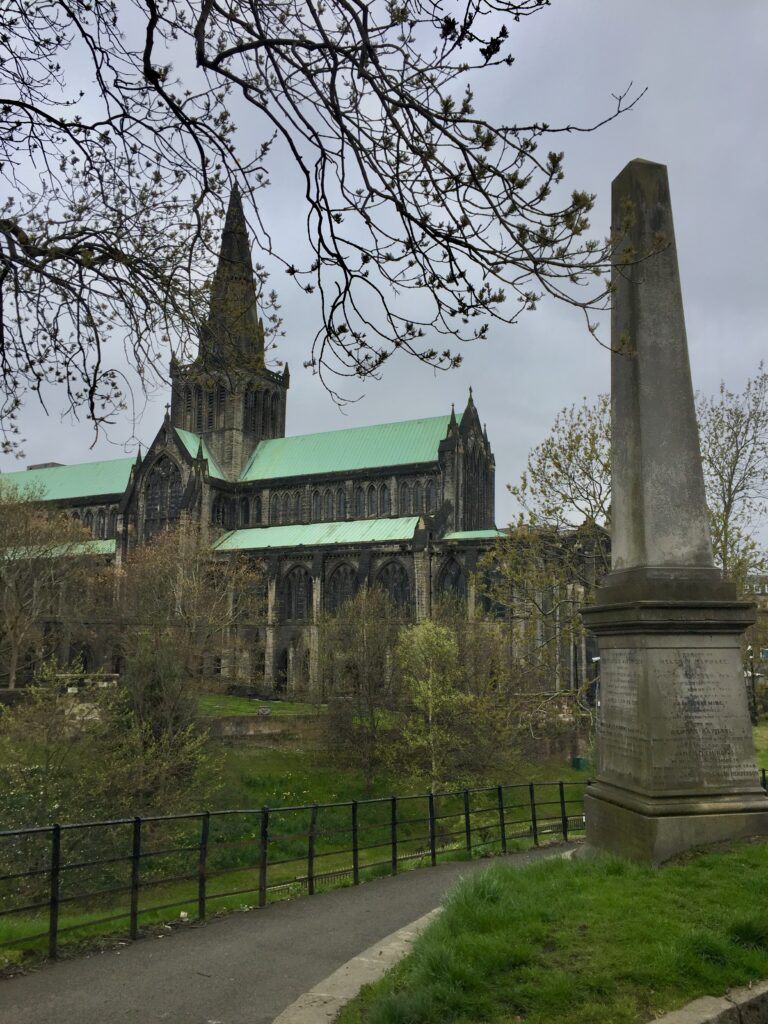
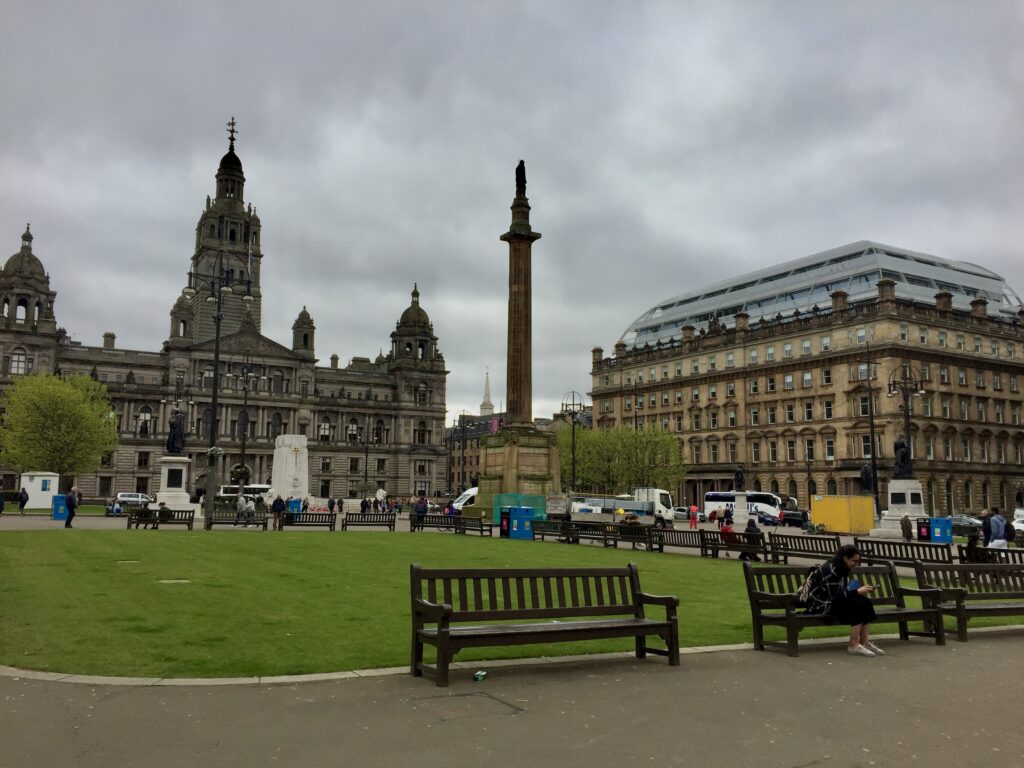
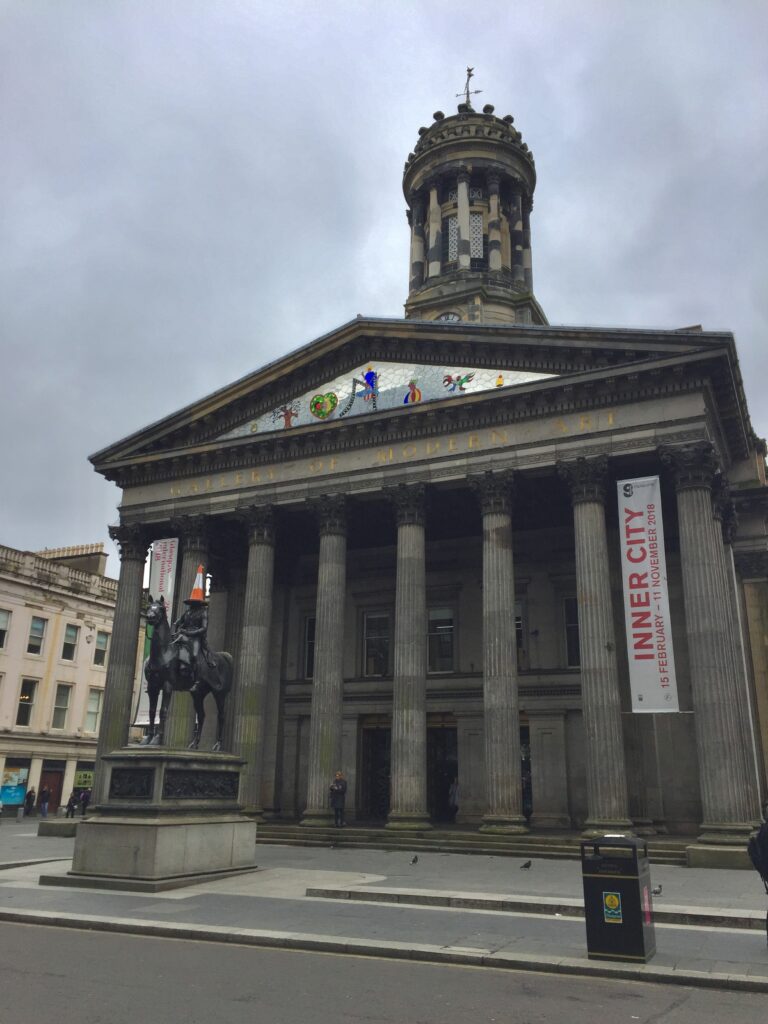
I visited Glasgow twice while I was living in Edinburgh, once on a day trip by myself and once with my family when they visited. Our favorite places in Glasgow are the Necropolis, a large cemetery on a hill by the cathedral that offers a beautiful stroll through lush greenery, and the Kelvingrove Art Gallery and Museum, where you can start your visit with a lesson on art before moving through the exhibits. One of Glasgow’s most notorious landmarks is the statue of the Duke of Wellington in front of the Gallery of Modern Art. Since the 1980s it has often been seen with a traffic cone on its head. City officials keep removing it and the people keep putting it back, sometimes decorating it for the times like showing support for the Scottish referendum in 2016 and for staying in the EU. It’s located near the central George Square. We also enjoyed getting fish n’ chips and checking out bakeries and cheese shops. I also, of course, tried the infamous deep-fried Mars bar.

Glasgow is located on the River Clyde, a natural fishing location, so the area in and around Glasgow has been inhabited for millennia. Outposts were constructed in the area by the Romans, and they also constructed the Antonine Wall nearby in order to separate Britannia from Caledonia, the Roman names for what is roughly modern day England and Scotland. In the 6th century the Christian missionary Saint Mungo founded Glasgow and established a church where the Glasgow Cathedral currently stands, and today the cathedral houses his remains. The city became a religious center and grew in population and culture over the next few centuries, with the Glasgow Fair starting in 1190 and the University of Glasgow being founded in 1451. The city’s elevation to Archdiocese from a bishopric in 1492 and its promotion to the status of Royal Burgh in 1611 increased Glasgow’s religious and cultural prestige as well as its trade industry and wealth.
Glasgow’s population didn’t surpass Edinburgh’s until 1821 during the industrial revolution, when Glasgow became a major industrial center. It became one of the first cities in Europe to reach a population of 1 million. Its population has decreased since then due to economic decline during the 20th century, though it went through a period of renewal in the 80s and 90s and continues to improve. Today, the residents of Glasgow are very proud to be Glaswegian and Scottish. The city has its own dialect of Scots and is the main center of Gaelic language use outside of the Highlands and Islands.