Trip notes
Was 5 days enough time?: If you stay near the city I’d say 5 nights is enough, and a day trip to Leshan is also doable, but you’ll need more time if you want to both really explore Chengdu and take a side trip to Mt. Emei.
Traveled solo?: Yes, and felt very safe
Time of year: Early November
Weather: It was cloudy the entire time and rained on two of the five days I was there. I saw maybe one or two patches of blue sky on my trip.
Who I think would particularly enjoy Chengdu: Anyone who loves both spicy food and pandas, provided they don’t mind cloudy weather for most or all of their trip.
What I read in Chengdu
- Shark’s Fin and Sichuan Pepper by Fuchsia Dunlop: A captivating food and travel memoir by a British chef who has dedicated her career to Chinese cuisine, and who has spent years living in and traveling throughout China. The book takes you all over China, but the first several chapters take place in Chengdu, the author’s first home in China and where she truly fell in love with its cuisine.
- The Poetry of Du Fu: Du Fu was a poet who lived in the 700s during the Tang Dynasty. He spent five years living in Chengdu where he wrote poems depicting a peaceful life at the Du Fu Thatched Cottage, which is now a museum dedicated to the poet.
- Sanxingdui and Chengdu: The Birth of a Myth by Lin Ganqiu: I unfortunately didn’t find out about this book until after my trip and wasn’t able to get my hands on it, but this looks like an excellent book to read about both Sanxingdui and broader Chengdu history.
- Anything about pandas: I searched for an adult non-fiction book about Giant Pandas but I couldn’t find one, so I read a NatGeo Kids magazine instead! I saw some educational books about pandas written in Mandarin at the Sanxingdui Museum gift shop, but I could not find anything in English that wasn’t aimed at children. So go ahead and read a kid’s book, or read about pandas online.
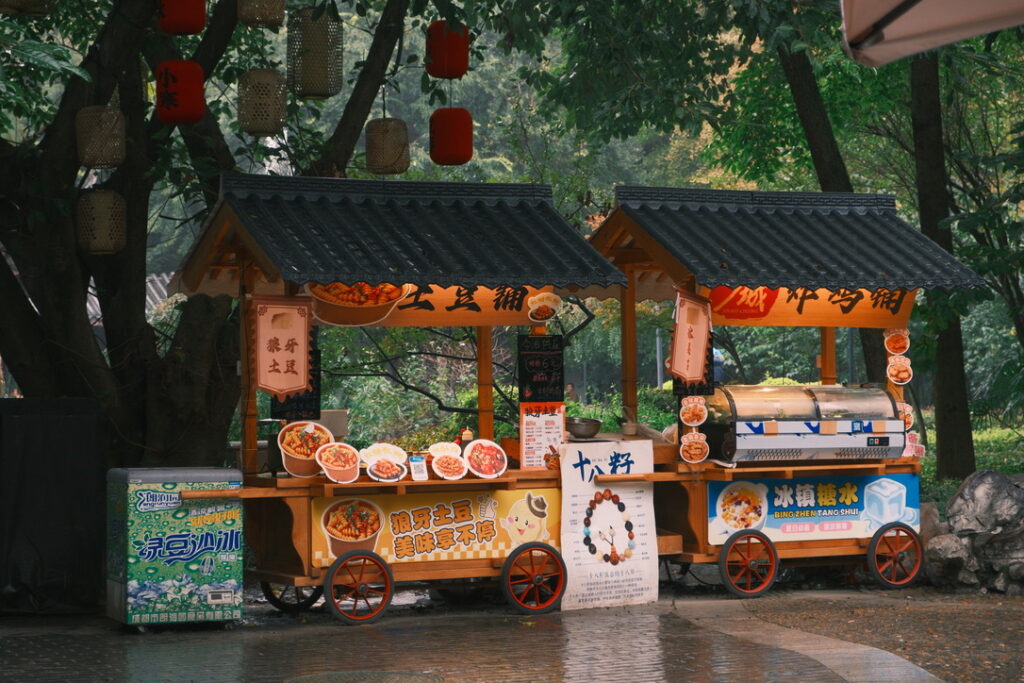
Chengdu itinerary
Day 0: Arrive at Chengdu airport late, check into my hotel after midnight, sleep
Day 1: Chengdu Research Base of Giant Panda Breeding, big Sichuan dinner
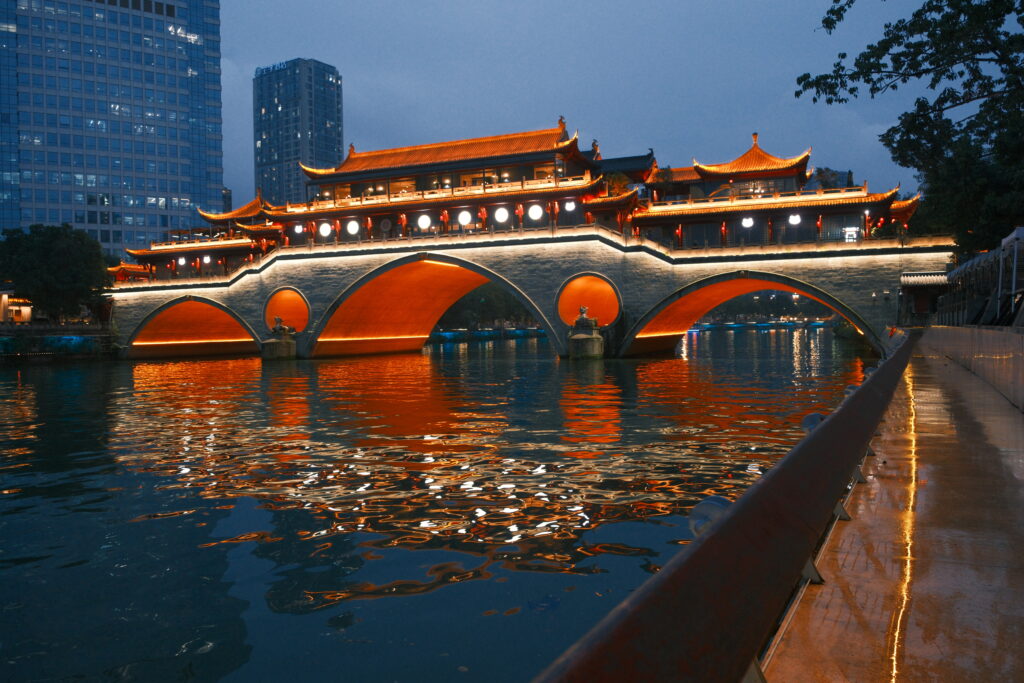
Day 2: People’s Park, Sanxingdui Museum, Anshun Bridge, Kuanzhai Alley
Day 3: Train to Leshan, Leshan Giant Buddha, check in to hotel in Emeishan
Day 4: Mt. Emei, back to Chengdu, walk around the city
Day 5: Wenshu Yuan Monastery, head to the airport
What I did in Chengdu
Nine years ago, my sister was living in Beijing on a study abroad program and I went to visit her. For US citizens, tourist visas for China cost the exact same no matter the visa duration. The longest duration available for a China travel visa is ten years, and I figured that if I have to pay $185 no matter what, I may as well get the ten year visa, so I did. Until my trip to Chengdu, I hadn’t visited China since. So with about a year remaining on my visa, I decided I would use it a few more times before it expires.
When I visited my sister, we spent most of the time in Beijing and took a side trip to Shanghai. At the time, those were the only two places in China I was familiar enough with to have an interest in visiting (well, besides two other places that would rather not be part of China). I learned more about Xi’an and Nanjing from my sister, but until recently most other places in China were, in my mind, a muddle of names I’d heard and images I’d seen that I couldn’t pair together. I knew there was one city out in western China that was famous for its panda conservation areas, and I knew there was a place called Sichuan where the spicy cuisine came from. Once I made the connection between Sichuan and pandas, I knew that I was headed to Chengdu.
Chengdu is the capital of Sichuan province and the fourth largest city in China. Home to spicy Sichuan cuisine and the Chengdu Research Base of Giant Panda Breeding, it is also, apparently, one of the cloudiest cities in China. I didn’t see the sun once while I was there, and only witnessed two short periods of warm sunlight shining through thin clouds. I assume the spicy food, relatively mild temperatures, and laid-back attitude keep the residents of Chengdu in good spirits, because the sun certainly isn’t around long enough to help much. The city also holds the distinction of being the only settlement in China whose name has remained unchanged throughout Chinese history: it has been called Chengdu (成都) for more than two thousand years.
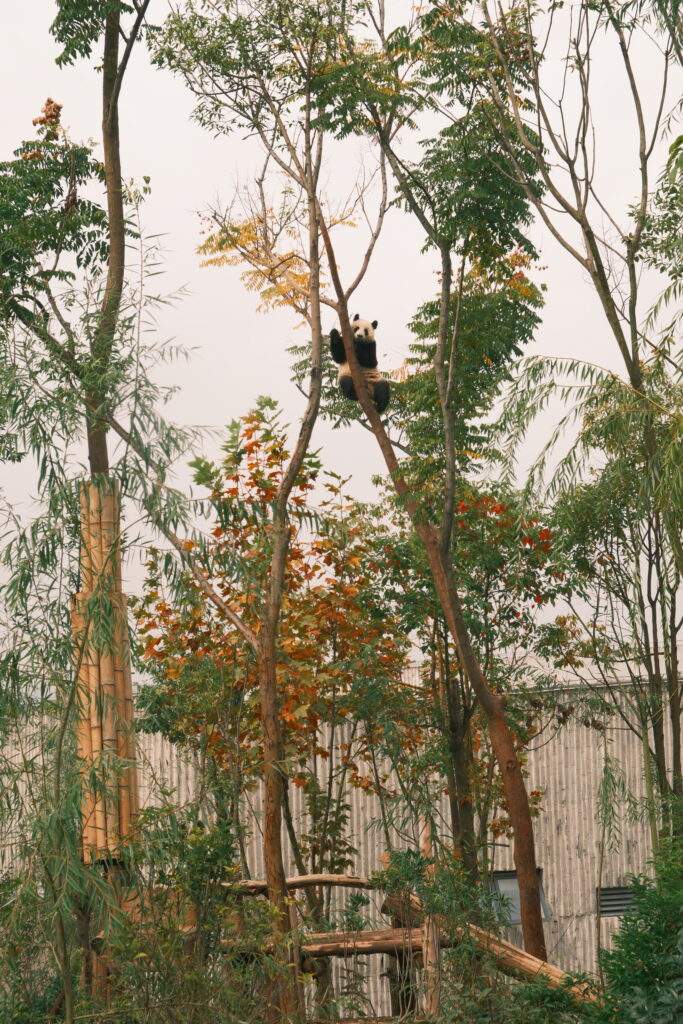
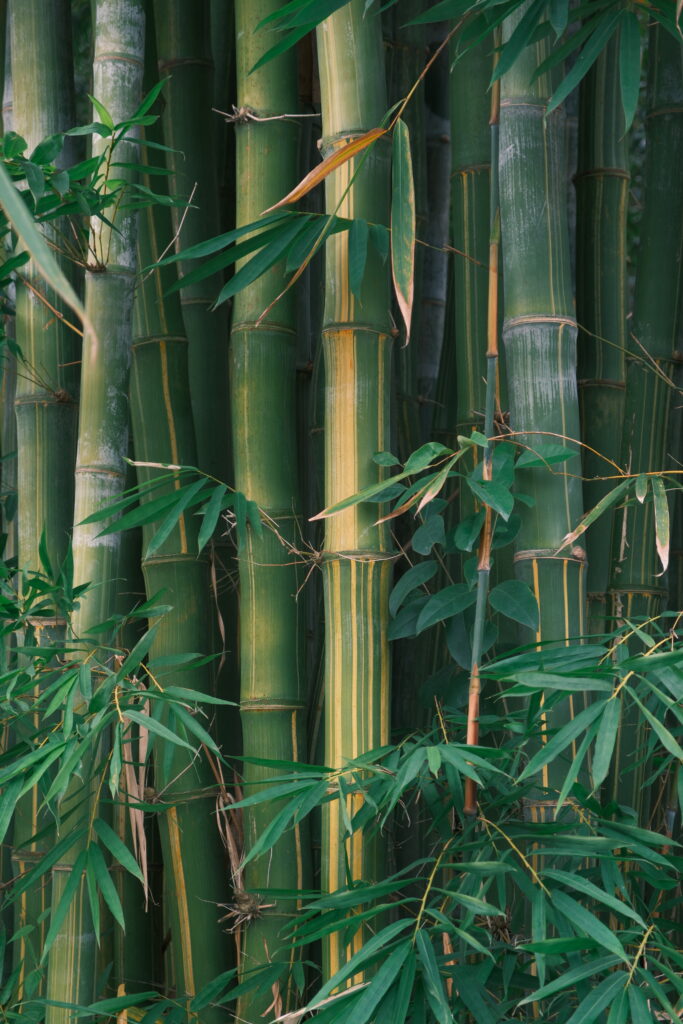
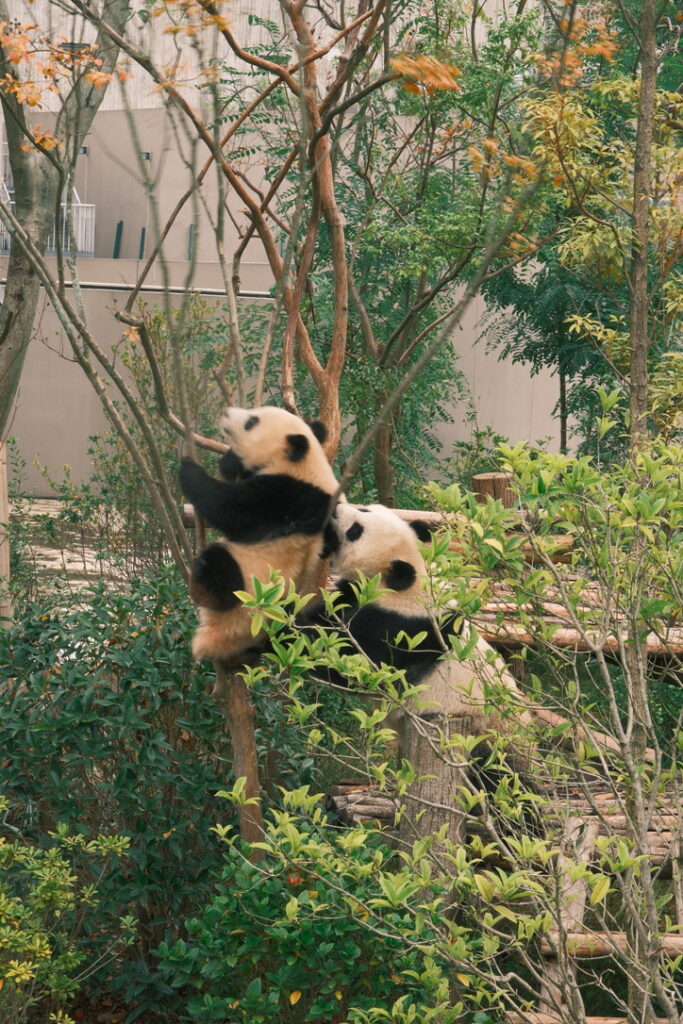
I arrived at night and was finally able to climb into my hotel bed a little after 1:00am, so I had a full day when I woke up the next morning. Of course, I went to see the pandas. The Chengdu Research Base of Giant Panda Breeding is massive. After entering through the panda-shaped gate, you end up on a deck that looks out over the entire park, and it is massive. I walked through the Singapore Zoo without getting on any of the shuttles that take you around the zoo, but looking out at the panda center grounds I was immediately aware I couldn’t do that here. The vastness suddenly made me aware that I would be at the park all day, alone among the families and couples here to see the pandas. Luckily, on the first shuttle ride I met a friendly Polish couple and I spent the rest of the day exploring the park with them, happy to have people to chat with on my first day in Chengdu.
We had all arrived at the panda center around 10AM, and were able to cover most of the park by about 4PM. The most typical sight at the park is adult pandas lounging around or eating bamboo, but we were also lucky enough to see some pandas playing. We weren’t sure if we’d get to see baby pandas, but luckily there was one area where we got to see four babies, which one of my new friends aptly dubbed “pandlings.” There is also a small section of the park dedicated to red pandas, which are more closely related to raccoons and skunks than the Giant Panda, but these smaller pandas do inhabit some of the same territory and also count bamboo as a major food source.
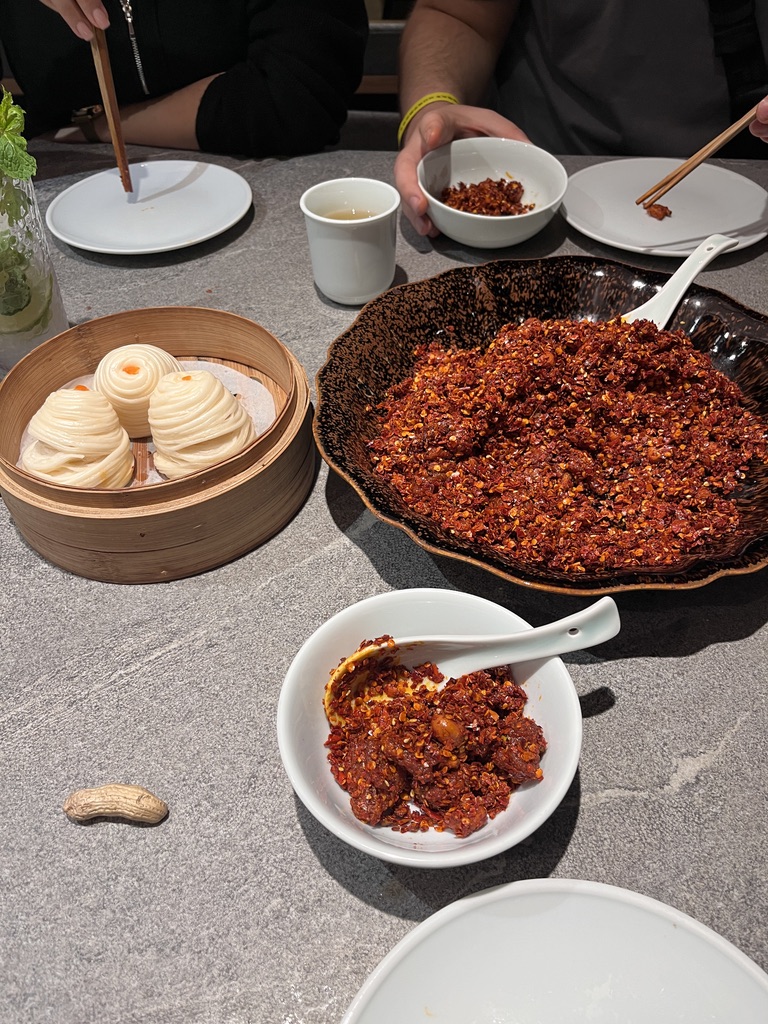
After spending the entire day watching pandas eat and relax, the three of us had a big Sichuan meal at Ma Wang Zi Chuan Restaurant. It is extremely popular even with locals, so we were told we could get in an hour and a half later. We walked around, got tea and checked out several shops before we finally sat down, and it was definitely worth the wait. We ordered a bunch of different dishes to try, all of which were excellent. Their signature dish is chicken that is absolutely drowning in Sichuan pepper. It made our mouths numb but it did not disappoint, and was hot without overpowering the flavor. I had a few other delicious meals in Chengdu during the following days, but this was definitely the best meal I had there.
One uncomfortable reality I faced while in Chengdu was the huge portions and inevitable subsequent food waste. Many Chinese restaurants serve the dishes that are meant to be shared in a group, something I love to do with friends and family, but it makes choosing places to eat in China difficult for solo travelers. I went to two of these places by myself, once for a spicy pork and vegetable stir fry and once for mapo tofu. Both times I was served heaping dishes for three or four people. They were of course delicious, and I ate as much as I could without stuffing myself to an uncomfortable degree, but still ended up leaving more than half behind. I left both restaurants feeling ashamed for eating alone and the food waste I had generated.
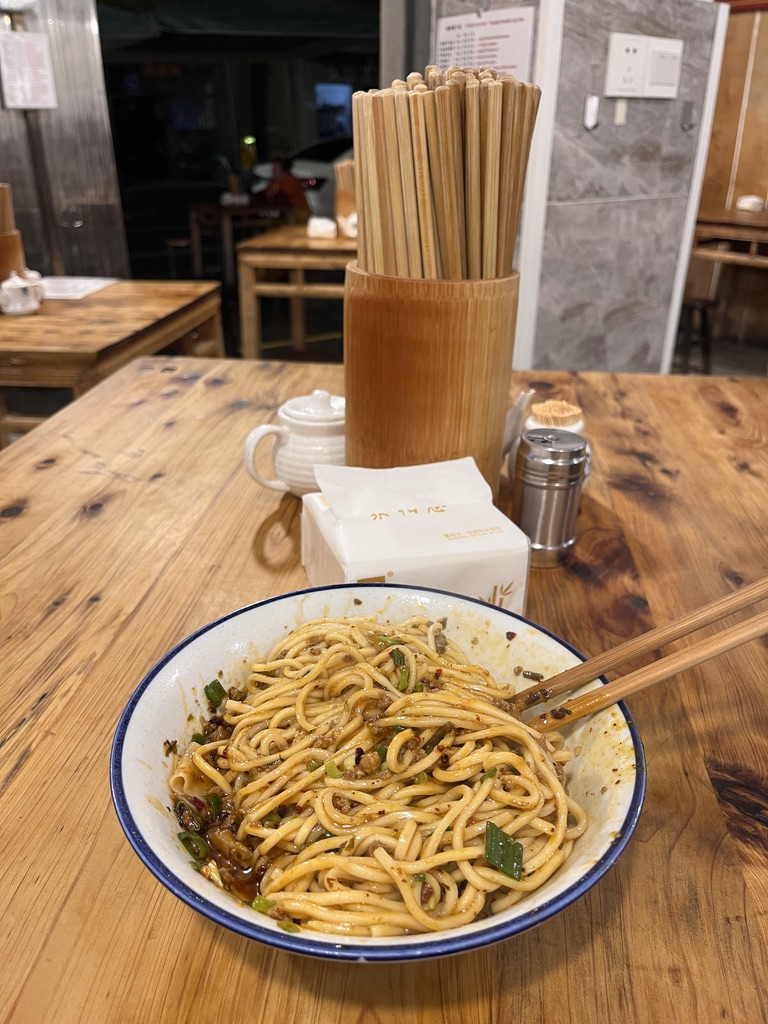
Yet as I was leaving the very same restaurants, I saw groups of people who had shared these dishes together leave behind heaps of food as well. I was reminded of what Fuchsia Dunlop wrote about the cooks for China’s imperial court at the end of the last dynasty, how they would make mountains of flavorless food that no one was eating simply to keep up appearances. Briefly I wondered if nonchalance about food waste is a cultural reality in China before deciding that was jumping to conclusions. Despite my guilt, perhaps solo travelers are only a small part of the problem. Still, casual noodle places where you can get a single serving are also common in China. I went to two excellent Dan Dan Noodles spots in Chengdu as well, so perhaps next time I should either frequent the noodle places, or find people to eat with as I did my first evening.
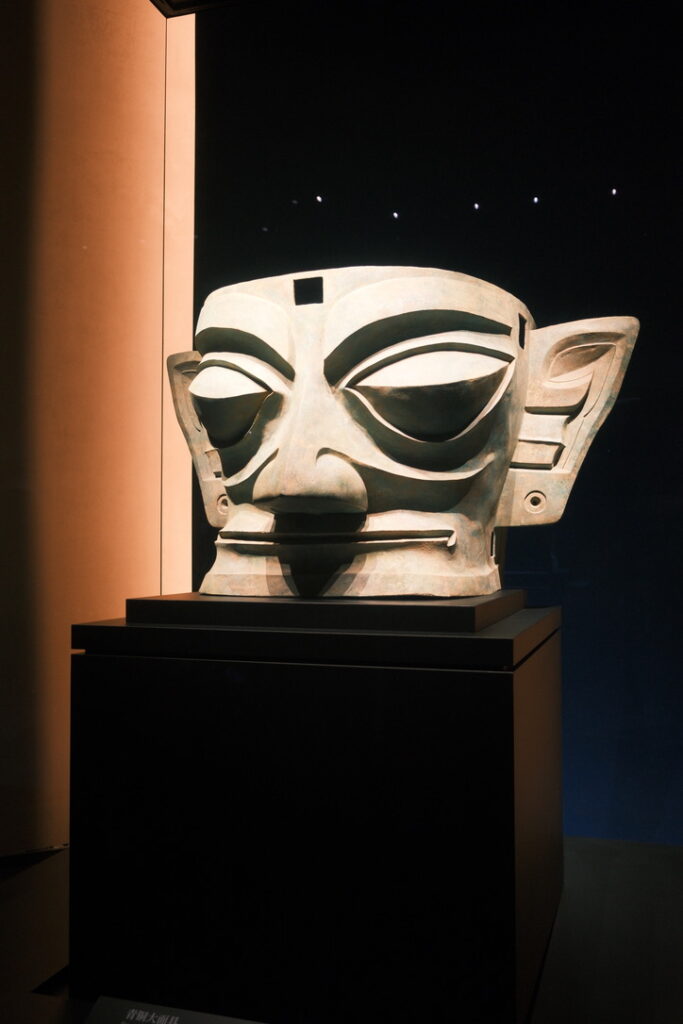
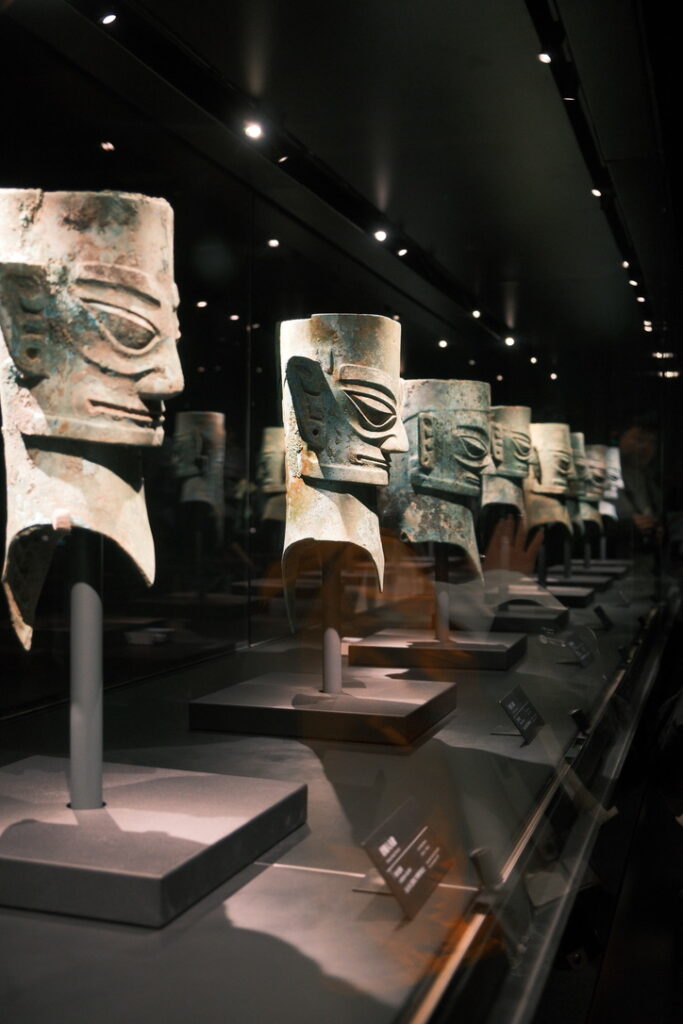
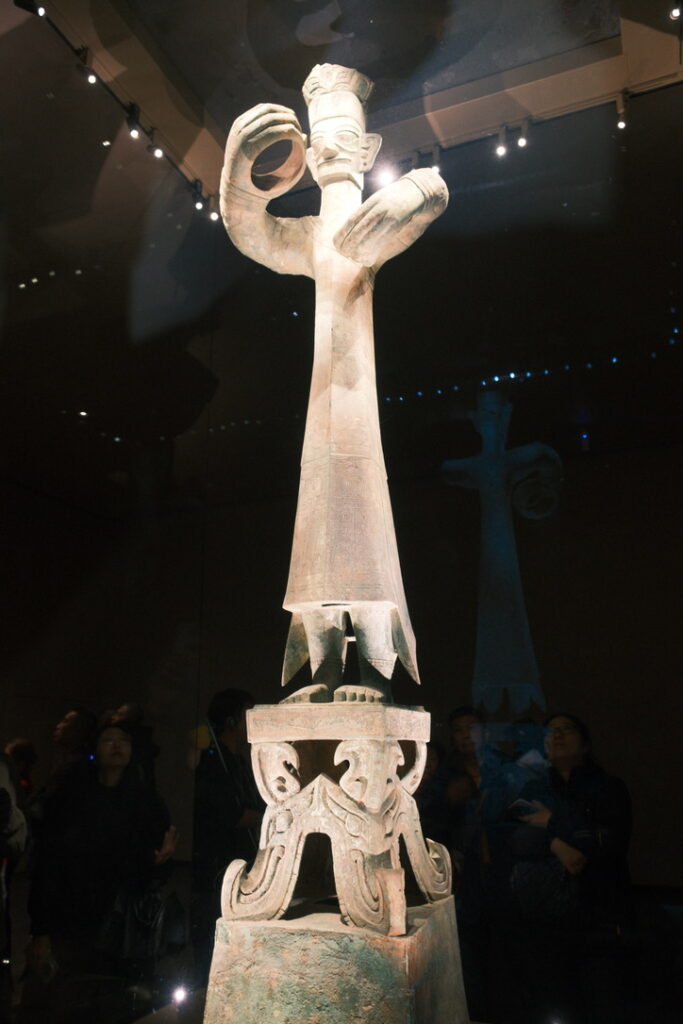
Anyways, after accomplishing my main Chengdu objectives – see pandas and eat tasty Sichuan food – on my first day, my second day I visited a much more mysterious attraction, the Sanxingdui Museum. It was pouring rain, and after walking through the People’s Park and Tianfu Square, I hopped on a bus that took me about an hour outside the city to the museum dedicated to this strange civilization that existed around the 12th to 11th centuries BCE. At the entrance to the exhibit, a sign declares that the Sanxingdui culture “[awakened] after millennia, astonishing the world” after workers stumbled upon artifacts in 1986. The museum is located right next to the archaeological site where researchers are still uncovering artifacts. The most striking of these artifacts are the numerous masks with alien-like faces, making it seem like the culture came from outer space. I spent several happy hours out of the rain learning about this fascinating civilization before heading back into the city and hunting down some Dan Dan noodles.
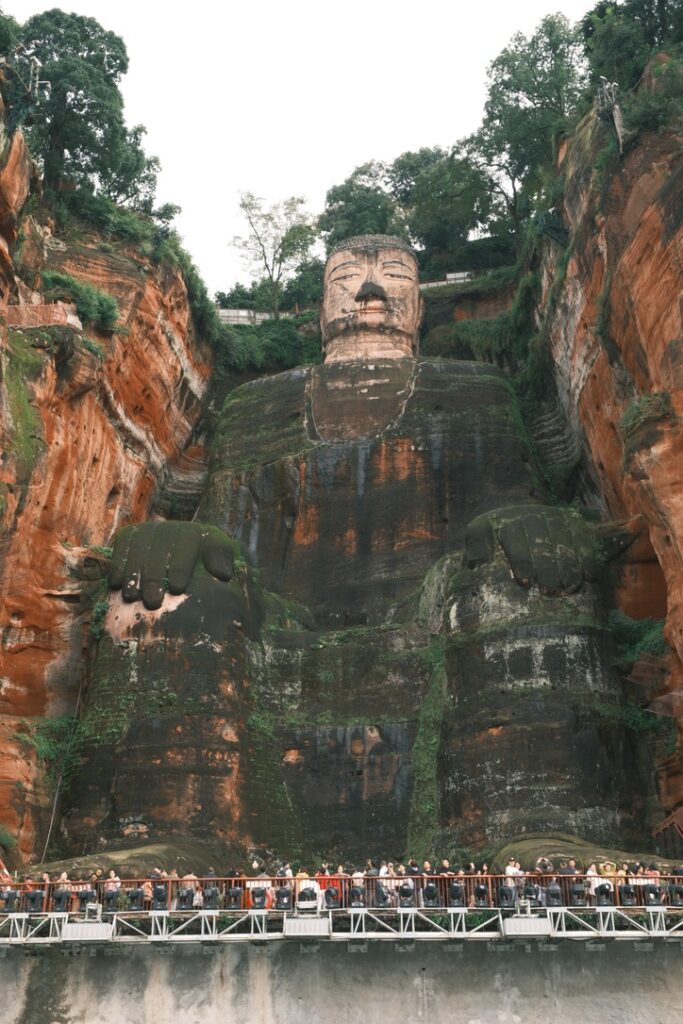
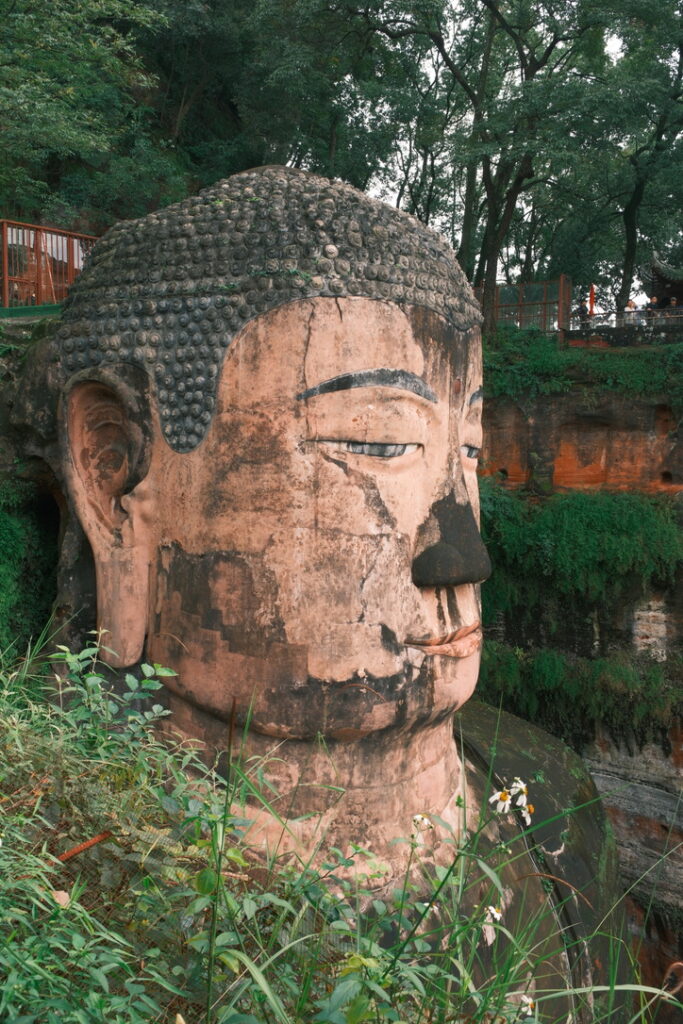
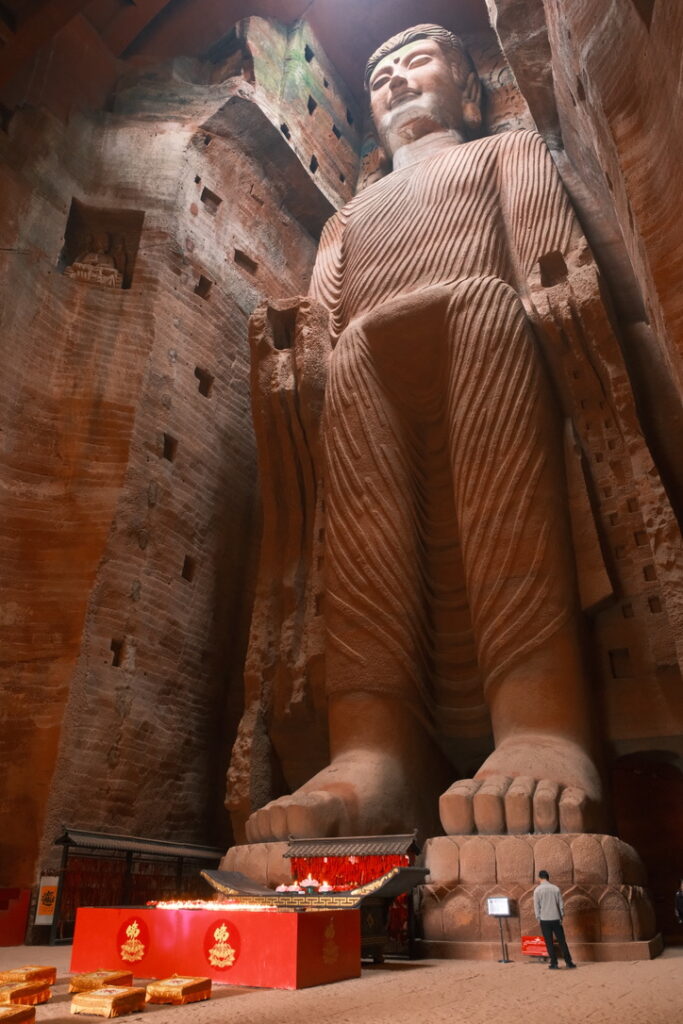
The following day I packed up and headed south toward the town of Leshan and its UNESCO-renowned Giant Buddha. The path that leads to the Giant Buddha winds through the forest and caves, which house other giant carvings of the Buddha. Some of these, I thought, would surely be more renowned were they not overshadowed by the main attraction, the colossal Buddha carved into the mountainside, who has been sitting and watching ships pass by on the river since the 700s. I made sure to view him from all possible angles. There are outlooks on both his left and right side, a platform by his feet, and there are also regular ferries that take visitors to catch a full view of him from the river. While I was on the ferry, beams of sunlight burst through the clouds and shined down on us for a few minutes, the only time that happened during my entire trip.
I started to regret my choices for the following day almost as soon as I arrived in Emeishan, a town at the foot of Mt. Emei, and checked into my hotel. I went through with my plans anyway. My hotel and room were both much less comfortable than where I stayed for three nights in Chengdu. I also felt much lonelier, and the weather report for the following day made me feel even worse. As expected, the next morning was rainy and misty. Feeling miserable about the day ahead, I got on the nearly two-hour bus ride that took me most of the way up Mt. Emei. It was so rainy and wet on the mountain that I bought a poncho at a tourist shop near the bus stop, then still had to walk up the stairs and take a cable car then climb more stairs to reach the top.
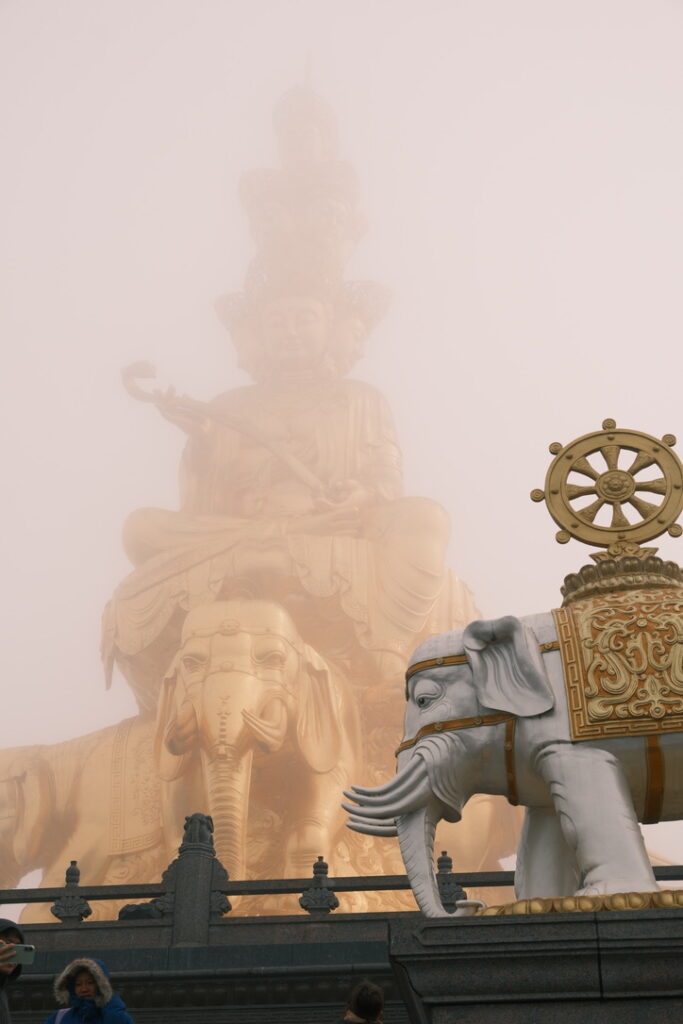
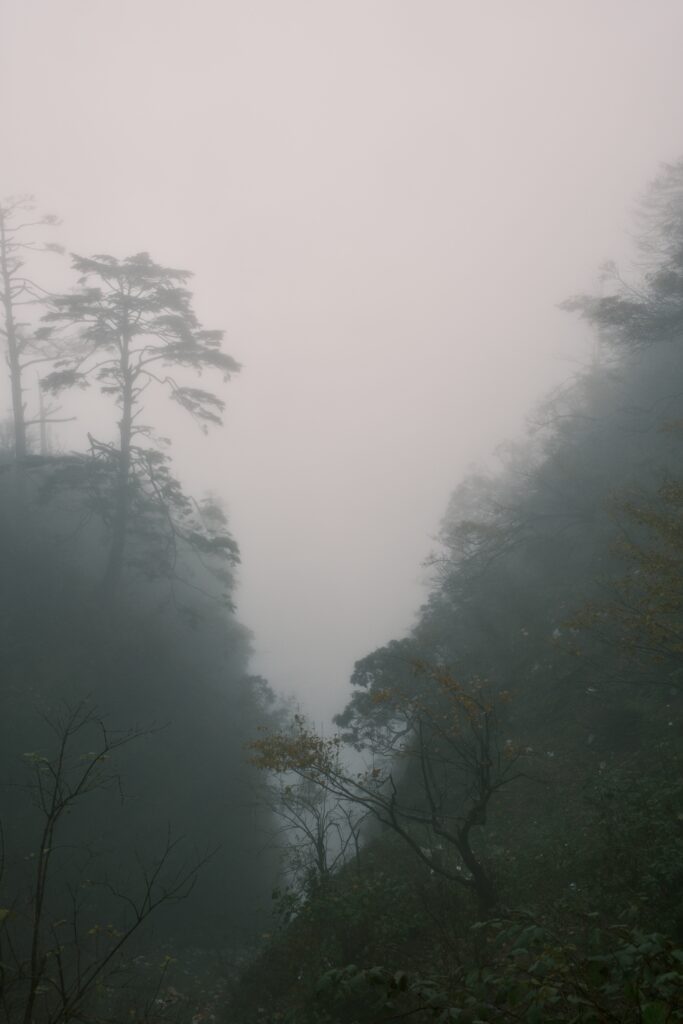
Mt. Emei is one of the four sacred Buddhist mountains of China, and along with Leshan it is a UNESCO World Heritage site. The photos of the mountain in better weather are really spectacular, but when I arrived the entire mountain was shrouded in mist. The giant golden statue of the Buddha atop four elephants was mystical in the fog. When I looked over the edge of the mountain, the precipice plunged into the mist. Perhaps aptly, this made the mountain feel otherworldly, but I love being at the top of a mountain and gazing out at the surrounding scenery. After such a long journey, and thinking about what I could have done had I returned to Chengdu instead, I remained disappointed by my choices.
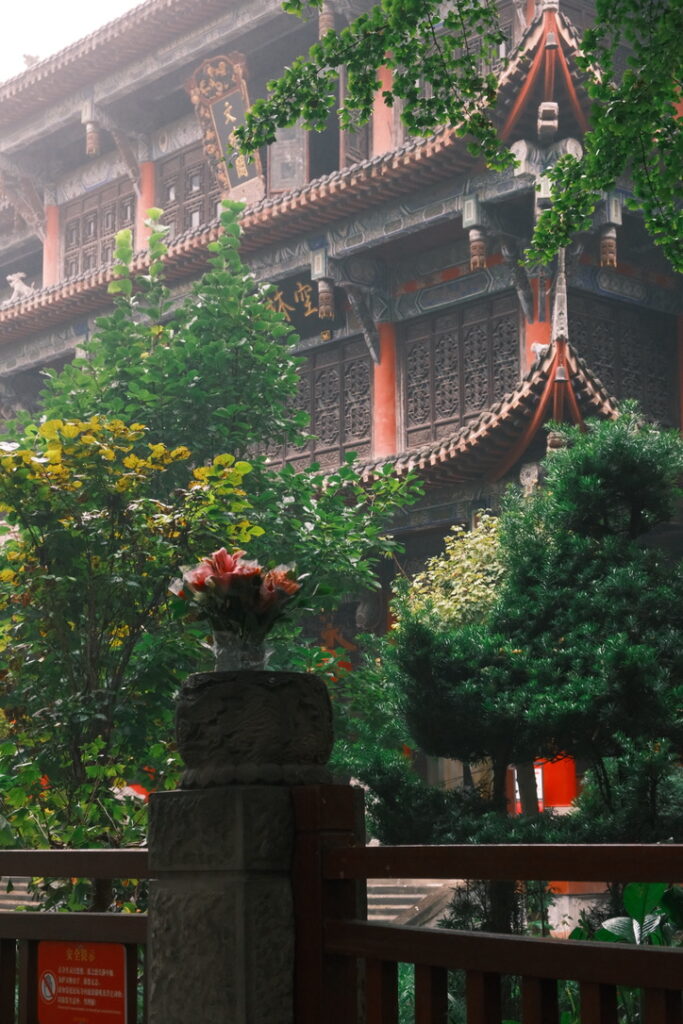
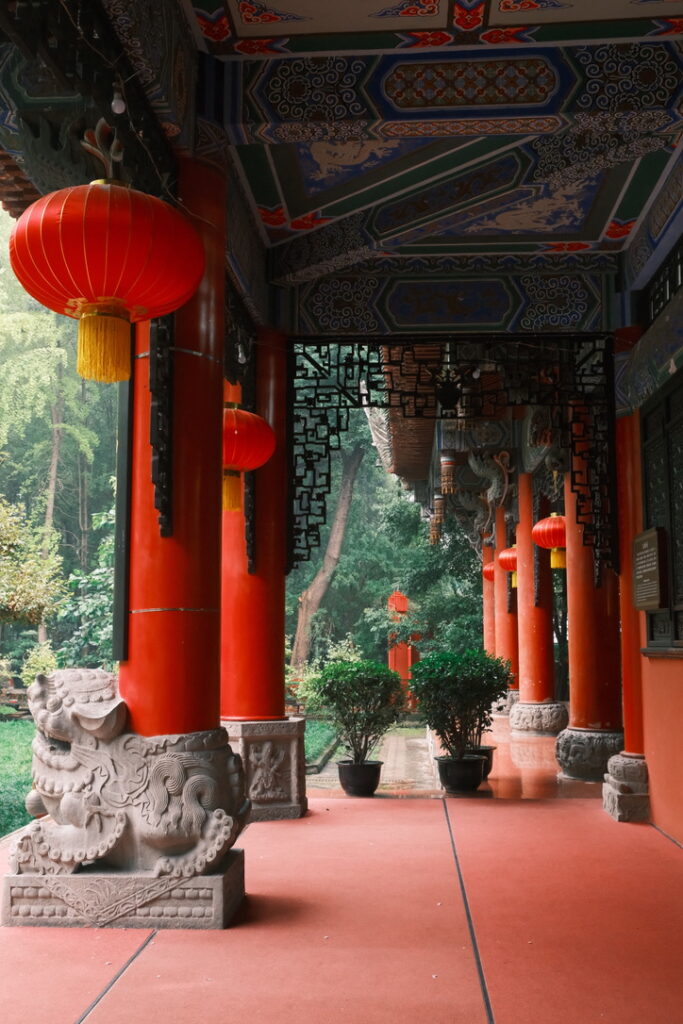
I arrived back in Chengdu later that evening, around the time the places I would have liked to visit were closing. After checking in to my hostel, I went to a popular restaurant and ate as much as I could of a multiperson serving of mapo tofu, walked around the area near my hostel, and then turned in for the night. The next morning I got up early and headed to the Wenshu Yuan Monastery. It was raining again, but rather than ruining my experience it made the monastery and its grounds feel calm and lush. There’s a beautiful cafe there that was closed during my visit. I would have loved to have breakfast there. I realized as I was about to leave how much I missed out on in Chengdu: the Sichuan Opera, the Du Fu Thatched Cottage, and Mt. Quingcheng. But I had come mainly for Sichuan food and pandas, so mission accomplished.

Local recommendations
I don’t know anyone from or who has lived in Chengdu, so this time I had to rely partially on research, partially on the accounts of two friends who have visited.
Sites
- Chengdu Research Base of Giant Panda Breeding
- Kuanzhai Alley
- Jinli Street
- People’s Park
- Sanxingdui Museum
- Sichuan Opera
- Leshan Giant Buddha (a day trip from the city)
- Mount Emei
- Mount Qingcheng
- Dujiangyan Irrigation System
Food
- Dan Dan Noodles
- Fish-fragrant eggplant
- Mapo Tofu

Eats
- 纯阳馆
- Street food in Kuanzhai Alley
- Ma Wang Zi Chuan Restaurant
- West Yuechengtan Tofu Pudding
- Chenmapo Tofu
Favorites
- The mouth-numbingly delicious Sichuan food
- Seeing pandas in their natural habitat
- Learning about the Sanxingdui civilization
- The cheap food and public transportation
- The Leshan Giant Buddha
What I would do differently
I love mountaintop temples, but I think instead of taking the time to visit and spend the night near Mount Emei, I would just take a day trip to the Leshan Giant Buddha, then return to Chengdu and see a Sichuan Opera performance. I also would have liked to take a day trip to Mount Qingcheng and the Dujiangyan Irrigation System, and head to the Du Fu Thatched Cottage. Granted, I’m sure I would have enjoyed my Mount Emei experience more if it hadn’t been so rainy.
Website: https://www.travelchengdu.com/jp/?spm=..index.header_1.1